
How We Raise Healthy, Well-Balanced Family Goldens
 Introduction
At Wisteria Goldens, our goal has always been to raise healthy, well-balanced Golden Retrievers that thrive as lifelong companions.
For over 20 years, we have focused on developing dogs known not only for their health, but for their temperament, trainability, and ability to integrate seamlessly into family life. Our program is built on the belief that a truly exceptional dog is not only structurally sound but also stable, intuitive, and a joy to live with day in and day out.
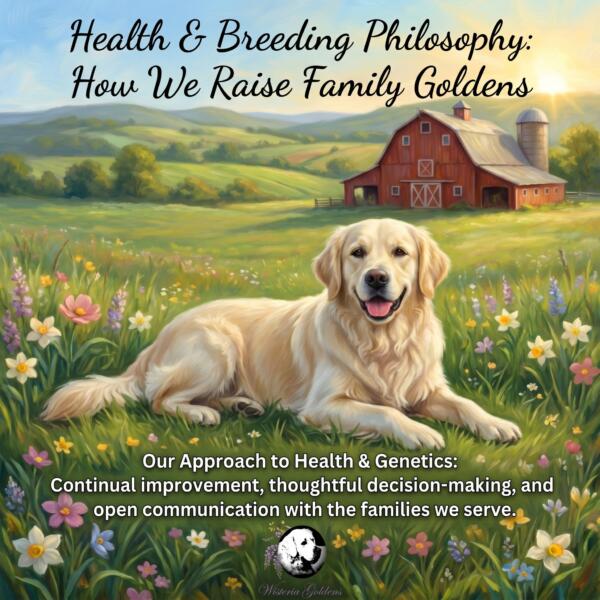
Over the years, our approach has continued to evolve as new research, testing methods, and insights into canine health and development have become available. We believe in continual improvement, thoughtful decision-making, and open communication with the families we serve.
While there are many perspectives within the breeding world, our focus has always remained consistent—raising well-rounded dogs that succeed in real homes. This real-world focus is reflected in the families who return to us, the referrals we receive, and the veterinarians who confidently recommend our program.
At the same time, we recognize that no breeding program can completely eliminate risk when working with live animals and genetics. Our role is to make informed, responsible decisions while continuing to learn and refine our program over time.
Our Approach to Health & Genetics
Health testing is one of the most important tools available to breeders—but it is important to understand what it does (and does not) do.
Health testing:
- Helps reduce the probability of inherited conditions
- Provides insight into structure, genetics, and risk factors
- Guides responsible breeding decisions
However, no testing protocol can guarantee that a puppy will never experience a health issue. Just like in humans, genetics is complex and unpredictable.
Our role as breeders is to stack the odds in favor of health and longevity as much as possible, while continuing to refine and improve our program over time.
Hip & Elbow Evaluations
We utilize multiple evaluation systems to gain a more complete understanding of joint health, including:
- Orthopedic Foundation for Animals (OFA)
- PennHIP
- British Veterinary Association (BVA)
Each evaluates hips and elbows differently:
- OFA provides certification based on radiographic evaluation at 24 months or older
- PennHIP measures joint laxity and estimates the statistical risk of developing hip dysplasia
- BVA uses a detailed scoring system that evaluates multiple structural points, offering a more in-depth breakdown of joint conformation
Rather than relying on a single method, we believe that using multiple evaluation systems provides a more comprehensive picture and enables more informed breeding decisions.
Understanding PennHIP Results
PennHIP evaluates joint laxity (looseness) and provides a statistical assessment of a dog’s risk for developing hip dysplasia over time. It may also identify existing signs of degenerative joint disease (DJD).
It’s important to understand that PennHIP primarily evaluates risk—not certainty. A higher score or a term like “mild” does not mean a dog will develop hip problems.
We use PennHIP as one piece of the overall picture—alongside pedigree history and additional evaluations—to guide responsible breeding decisions.
Cardiac (Heart) Clearances
We prioritize evaluations performed by a board-certified veterinary cardiologist whenever possible, as these provide the most accurate assessment. Current best practices increasingly recommend echocardiograms for a more comprehensive evaluation of heart structure and function.
Due to our rural location, access to veterinary cardiologists can sometimes be limited. To ensure we continue to meet the level of evaluation we prefer, we have partnered with a traveling cardiology clinic that will come to our location to complete these assessments. We are excited to have access to this level of care as their practice expands into Arkansas.
We are always looking for ways to continue improving our program and are grateful to have access to these expanded resources.
Breeding Decisions & Real-World Considerations
While our goal is to keep all testing as current as possible, there are times when decisions must be made based on:
- Multi-generational health history
- Prior clearances
- Overall consistency within a line
- Availability of specialized veterinary services
No breeding program is perfect, and responsible breeding involves making the best possible decisions with the information and resources available at the time, while continuing to improve.
Our Commitment to Improvement
Over the years, we have:
- Adjusted pairings when needed
- Expanded our health testing protocols
- Added additional genetic screening
- Continued learning as new research becomes available
This is not a static process—it is an ongoing commitment.
Addressing Past Concerns
Over a decade ago, we experienced a situation involving joint concerns in a puppy. We took responsibility, worked directly with the family, and made changes within our breeding program, including discontinuing that pairing.
Since that time, we have continued to refine and strengthen our program.
While isolated issues can occur in any breeding program, they do not define the overall health, care, and experiences of the many families we have worked with over the years.
Common Questions About Our Health Testing
Do you test your dogs’ health?
Yes. All of our breeding dogs undergo health evaluations, including hip and elbow evaluations, cardiac screening, and genetic screening.
Why don’t you post all health clearances publicly?
We provide detailed documentation directly to families and take time to explain the results so they are properly understood. Health testing is not just about having paperwork—it’s about interpreting it responsibly.
Understanding PennHIP Results (Detailed)
PennHIP evaluates hip joint health by measuring joint laxity (looseness) using a value called the Distraction Index (DI).
The DI score ranges from 0 to 1:
- Lower scores indicate tighter hips and a lower statistical risk of developing hip dysplasia
- Higher scores indicate more looseness and a higher statistical risk
PennHIP uses three radiographic views to evaluate the hips, providing a more complete picture of both joint structure and stability. It can also identify existing signs of degenerative joint disease (DJD) at the time of evaluation.
You may sometimes hear PennHIP results described in general terms such as low, mild, or moderate risk. These are informal ways of interpreting the DI score and how a dog compares within the breed.
It’s important to understand:
- PennHIP primarily evaluates risk—not certainty
- There is no “no-risk” category—all dogs fall somewhere along a spectrum
- A higher DI or “mild/moderate” description does not mean a dog will develop hip dysplasia
- Many dogs with moderate scores live completely normal, active lives without issue
We use PennHIP as one piece of the overall picture—alongside pedigree history and additional evaluations such as OFA and BVA—to make thoughtful, informed breeding decisions.
Myths vs Facts About Breeding & Health Testing
There is a lot of information online about dog breeding—some accurate, some misunderstood, and some based on isolated or outdated experiences. We believe it’s important to clarify a few common misconceptions to help families make informed decisions.
TIP: Click on each Myth below to see the Facts.
Transparency & Communication
We are proud members of the AKC Bred with H.E.A.R.T. Program. This program reflects a commitment to Health, Education, Accountability, Responsibility, and Tradition—values that align closely with how we have built and continue to grow our program.
As with many long-standing breeders, you may come across information online that dates back many years. We encourage families to consider the timeframe and to focus on current practices, communication, and real-world results.
We are an open book and are always happy to share up-to-date health clearances and DNA test results, and to answer any questions so families feel confident and informed in their decision.
We understand that choosing a breeder is an important decision, and we welcome thoughtful conversations. We encourage families to:
- Consider the timeframe of the information
- Seek direct communication
- Ask questions and review current practices
We are always happy to provide information, answer questions, and have open, honest conversations about our program.
This real-world focus is reflected in the families who return to us, the referrals we receive, and the veterinarians who confidently recommend our program.
Final Thought
We don’t believe in perfection—we believe in responsibility, transparency, and continual growth.
Wisteria Goldens : English Cream Golden Retrievers
 Available Puppies Trained Puppy Availability Adoption Process Golden Pet Safety Guide
We love to provide information to our families to support and increase the optimal health of their puppies, as well as into adulthood increasing the longevity of their life!
Join our fastest growing “Happy Families” community on Instagram! Use #wisteriagoldens and your puppy’s litter social hashtag. Submit your Wisteria Goldens Puppy Update here: Puppy Update